

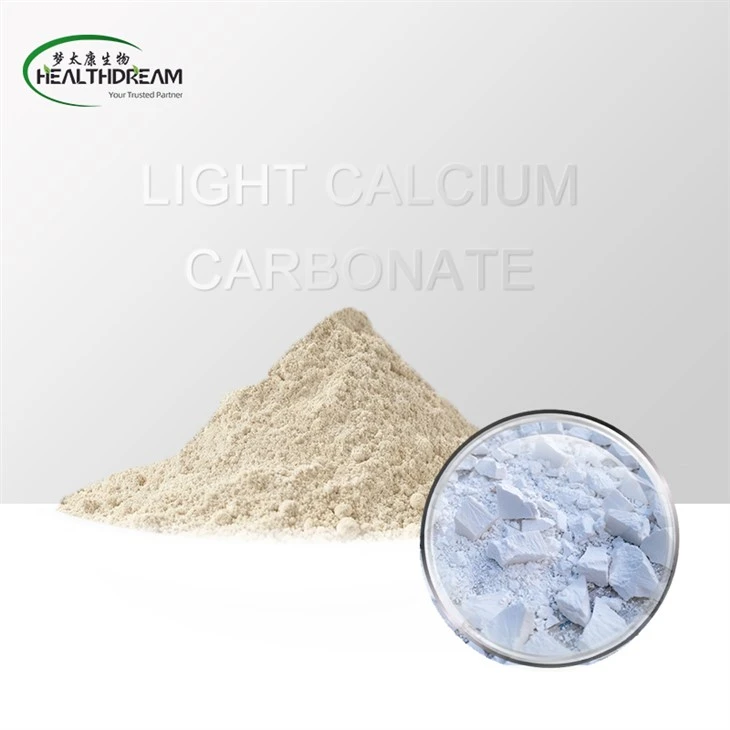




Light Calcium Carbonate


What is the difference between light and heavy calcium carbonate?
Light calcium carbonate features a relatively low bulk density, mostly ranging from 0.5 to 0.7g/cm³, while that of heavy calcium carbonate generally falls between 0.8 and 1.3g/cm³. Light calcium carbonate has high purity with a whiteness degree of 92%–97%, whereas the whiteness degree of heavy calcium carbonate is 89%–93%. Light calcium carbonate offers excellent reinforcing properties, and heavy calcium carbonate is mainly used as a filler.

|
Product name: |
Light calcium carbonate |
|
Appearance: |
White powder |
|
Specification: |
NLT 98% |
|
MOQ: |
25kg |
|
Packing: |
25kg/drum |
|
Storage: |
Store in a cool and dry place, protect from heat |
|
Shelf life: |
24 Months when properly stored. |
|
Certificate: |
ISO9001, FSSC22000, etc |

|
Product name: Light calcium carbonate |
|
|
Items |
Specification |
|
Appearance: |
White powder |
|
Calcium Carbonate Content: |
NLT 98% |
|
Whiteness: |
NLT 93% |
|
Particle Size: |
2 ~ 5 μm |
|
Iron: |
≤ 50 ppm |
|
Insolubles in hydrochloric acid: |
≤ 0.20% |
|
Sulfate: |
≤ 0.10% |
|
pH Value (10% Suspension): |
8.0–10.0 |
|
Loss on Ignition: |
≤ 4.00% |
|
Moisture: |
≤ 0.30% |
|
Pb: |
≤ 10 ppm |
|
As: |
≤ 3 ppm |

Paper Making Industry
Applied in cultural paper, coated white board, coated art paper and other paper products. When added to pulp or coating layers, it improves paper whiteness and opacity, and optimizes color reproducibility after printing.
Coatings Industry
Used as an extender brightening pigment in interior latex paint, exterior wall paint, wood paint and other products. It enhances the whiteness and hiding power of paint films, and reduces the dosage of high-cost titanium dioxide.
Plastics Industry
Applied in white or light-colored plastic products including PVC profiles, PE/PP injection-molded parts, plastic films, and home appliance casings, to improve surface whiteness and gloss uniformity of the products.
Rubber Industry
Used in white or light-colored rubber products such as white tire sidewalls, silica gel products, and rubber seals, to enhance the whiteness and surface cleanliness of rubber products.
Building Materials Industry
Incorporated into materials like putty powder, tile adhesive, white gypsum board, and interior wall mortar, it improves the surface whiteness of building materials to meet the demand for light-colored substrates in interior decoration.
Daily Chemicals & Cosmetics Industry
Added to white foundation, talcum powder, skin-whitening care products and other items. It leverages its high whiteness to adjust the appearance color of products, while also providing auxiliary functions of adsorption and smoothness.

Excellent Physical Properties
It features a small and uniform particle size, high whiteness (usually over 90%), presents as an odorless white powder. With a low bulk density of approximately 0.5–0.7g/cm³, it boasts superior dispersibility and can be easily blended uniformly with other materials.
Stable Chemical Properties
Its main component is calcium carbonate, which ensures high chemical stability. It is insoluble in water and ethanol, does not readily react with substances other than acids at room temperature, and exhibits good weather resistance and corrosion resistance.
Distinct Cost Advantage
Derived from widely available raw materials with mature production processes, it is cost-effective and offers much higher cost-performance than high-end white fillers such as titanium dioxide.
Mild Whitening Effect
Thanks to its high inherent whiteness, it can effectively enhance the whiteness and gloss of products. The whitening mechanism relies on physical masking rather than chemical reaction with the materials, making it suitable for scenarios requiring mild whitening, such as papermaking, coatings, and plastics.
Dual Functions of Filling and Whitening
Acting as both a whitening agent and a filler, it increases product volume and reduces production costs. Additionally, it improves product properties including rigidity, heat resistance, and printability.

Q1: Why is light calcium carbonate white?
Light calcium carbonate appears white mainly due to its hexagonal crystal structure and uniformly fine particle size. It does not absorb visible light but scatters incident light in all directions through physical diffuse reflection. All wavelengths of light are reflected evenly to the human eye, thus appearing white. This property also makes it a high-quality white filler.
Q2: What are the three types of calcium carbonate?
Calcium carbonate is mainly divided into three types: light calcium carbonate, heavy calcium carbonate and activated calcium carbonate. Light calcium carbonate is produced by chemical synthesis, featuring fine particle size and high whiteness. Heavy calcium carbonate is made by grinding natural ores, with low cost and a wide particle size range. Activated calcium carbonate undergoes surface modification, and has better dispersibility and compatibility.
Q3: Is light calcium carbonate safe?
Light calcium carbonate has high safety. As an inert inorganic powder, it features stable chemical properties and does not participate in human metabolism. Certified by food safety standards of multiple countries, it can be legally used in food, daily chemical and other fields. When used as a whitening agent, it functions only through physical scattering, without chemical toxicity. Under normal application conditions, it poses no harm to human health or the environment.
Hot Tags: light calcium carbonate, China light calcium carbonate manufacturers, suppliers, factory
Send Inquiry
