

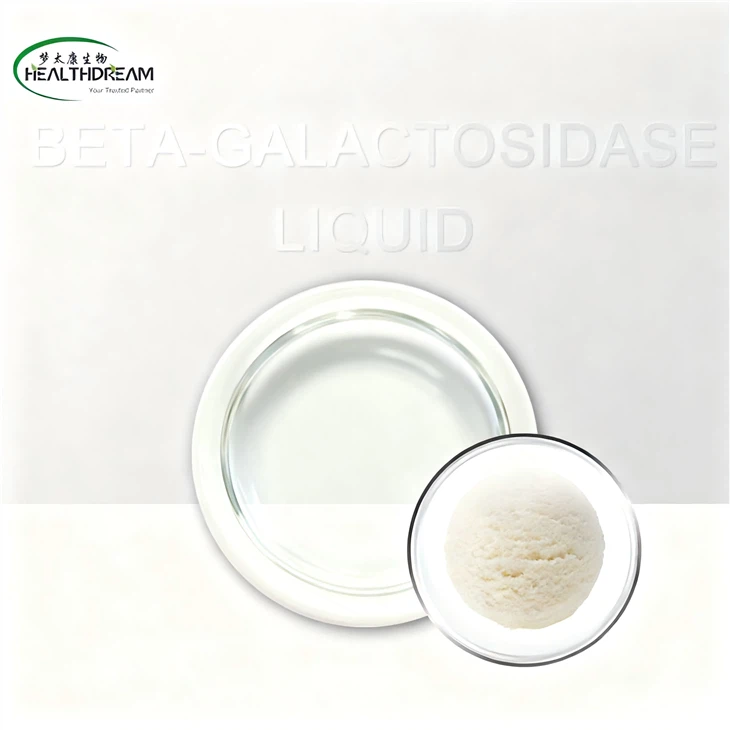


5,000 ALU/g Beta-galactosidase Liquid


Is β-galactosidase lactase?
Yes, β-galactosidase, commonly known as lactase, is the enzyme that hydrolyzes lactose into glucose and galactose. In the dairy industry, it is referred to as lactase, especially in products labeled as lactose-free or low-lactose, while the term β-galactosidase is more often used in scientific and industrial contexts. Chemically, they are the same enzyme, performing the same function of breaking down lactose.

|
Product name: |
β-galactosidase |
|
source: |
Aspergillus Oryzae |
|
Technology : |
Fermented |
|
Appearance: |
Transparency liquid |
|
Product odor: |
Free of offensive odors |
|
Enzyme activity: |
5,000 ALU/g or customized |
|
MOQ: |
1L |
|
Packing: |
5L/drum; 25L/drum |
|
Storage: |
In a cool and dry environment away from light. |
|
Shelf life: |
12 Months under room temperature 18 Months under 15℃ 24 Months under 4℃ |
|
Optimum environment: |
38℃~40℃; pH 5.0 |
|
Other influencing factors: |
Oxidation inhibitor; Reducing substances, like active ion Ca2+, Mg2+, Na+; K+ ect. |
|
Certificate: |
ISO9001,FSSC22000 |
|
Recommended dosage: |
When β-galactosidase with an enzyme activity of 5000 ALU/g is used for milk powder formulation, the recommended dosage is 40–50 ml per 1 kg of milk powder. |

|
Product Name: β-galactosidase |
|
|
Appearance: |
Transparency liquid |
|
Odor: |
Free of offensive odors |
|
Activity of enzyme: |
NLT 5,000 ALU/g |
|
Loss on drying: |
NMT 8.0% |
|
Heavy metals: |
<20.0mg/kg |
|
Arsenic: |
<5.0mg/kg |
|
Lead: |
<3.0mg/kg |
|
Total Plate Count: |
NMT 10,000cfu/g |
|
E. Coli: |
<10cfu/g |
|
Coliform: |
<10cfu/g |
|
Salmonella: |
Negative/10g |
|
Staphylococcus Aureus: |
Negative/10g |
|
Yeasts/moulds: |
<100cfu/g |
|
Storage: In a cool and dry environment away from light. Shelf Life: It can be stored for 24 months in an airtight container at 4℃, 18 months at 15℃, and 12 months at room temperature. |
|

1.Lactose-Free Dairy Production:
Liquid β-galactosidase hydrolyzes lactose in milk and dairy products, making them suitable for lactose-intolerant consumers while improving sweetness and digestibility without altering flavor.
2.Infant Formula Processing:
Used to pre-digest lactose in infant formulas, ensuring better tolerance for babies with sensitive digestive systems and maintaining nutritional value.
3.Ice Cream and Concentrated Milk
Due to the low solubility of lactose, frozen products may develop a grainy texture. Adding lactase reduces lactose crystallization in ice cream, concentrated milk, and evaporated milk, while enhancing sweetness, aroma, and overall flavor.
4.Yogurt Processing
During yogurt fermentation, normally only about 20% of lactose is broken down. Adding lactase can hydrolyze up to 90% of lactose, reducing fermentation time by around 30%, increasing viscosity, and enhancing both milky aroma and texture. In low-lactose yogurt, lactic acid bacteria grow faster, colony counts are higher, and shelf life is significantly extended.

Thermal Stability: Lactase retains its activity within a moderate temperature range, typically between 38°C to 40°C, with optimal performance.
Enhanced Sweetness and Flavor Formation: when lactose is hydrolyzed into glucose and galactose, sweetness intensity increases by approximately 20–25%, enhancing the sensory quality of dairy beverages without added sugars.
pH Stability: β-galactosidase operates effectively within a pH range of 4.5–6.5, with peak activity at pH 5.0. This makes it suitable for use in dairy products.
Reduced Allergenicity and Clean Label Ingredient: as an enzyme derived from non-GMO, food-grade microorganisms, β-galactosidase supports clean-label formulation trends and minimizes allergen risk.

Q1:What is the function of β-galactosidase?
A1:The functions of β-galactosidase can be summarized as follows:
1. Lactose hydrolysis: Breaks down lactose into glucose and galactose, enabling lactose digestion and making it suitable for lactose-free or low-lactose products.
2. Sweetness enhancement: Increases the natural sweetness of dairy products by converting lactose into simpler sugars.
3. Fermentation aid: Provides fermentable sugars for lactic acid bacteria, accelerating fermentation in yogurt and other dairy products.
4. Prebiotic production: Produces galacto-oligosaccharides (GOS), which support gut health and are used in functional foods.
5. Acidic environment suitability: Maintains high activity under acidic conditions, making it ideal for products like yogurt, fermented beverages, and infant formula.
Q2:What foods contain beta-galactosidase?
A2:Foods themselves do not naturally contain active β-galactosidase in significant amounts, but certain foods are associated with the enzyme or its activity:
1.Fermented dairy products: yogurt, kefir, and some cultured milk products contain live cultures (lactic acid bacteria) that produce β-galactosidase during fermentation, which helps partially break down lactose.
2.Lactose-free or low-lactose milk: these products are treated with added β-galactosidase (lactase) to hydrolyze lactose.
3.Dietary supplements: β-galactosidase is available as lactase tablets or drops for individuals with lactose intolerance.
Q3:What happens if beta-galactosidase is low?
A3:If β-galactosidase (lactase) levels are low, the body cannot efficiently digest lactose, the sugar found in milk and dairy products. This leads to lactose intolerance, which can cause the following effects after consuming lactose-containing foods:
1.Digestive discomfort: Bloating, stomach cramps, and abdominal pain.
2.Gas production: Undigested lactose is fermented by gut bacteria, producing gas (flatulence).
3.Diarrhea or loose stools: Lactose draws water into the intestine, causing diarrhea.
4.Nausea or rumbling: Some individuals may feel nausea or intestinal rumbling.
Hot Tags: 5,000 alu/g beta-galactosidase liquid, China 5,000 alu/g beta-galactosidase liquid manufacturers, suppliers, factory, Alkaline Protease, Amylase, Cu Zn Superoxide Dismutase SOD , Cu/Zn-Superoxide Dismutase(SOD), Pancreatin, Papain
Send Inquiry
