

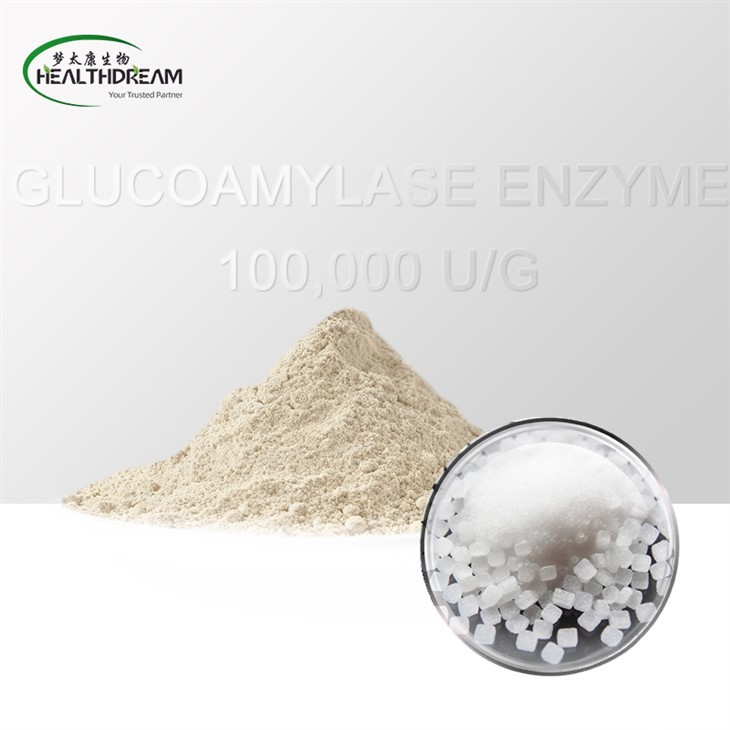



Glucoamylase Enzyme 100,000 U/g


What is Glucoamylase?
Glucoamylase is an exo-acting enzyme that hydrolyzes starch and other polysaccharides into glucose by cleaving α-1,4 and, to a lesser extent, α-1,6 glycosidic bonds from the non-reducing ends of the molecules. It is widely applied in the food, brewing, and baking industries for glucose syrup production, as well as in bioethanol and industrial fermentation processes, due to its high efficiency in converting starch into fermentable sugars.

|
Product name: |
Glucoamylase |
|
Main components: |
Glucoamylase, Glucose |
|
Grade: |
Food Grade |
|
source: |
Aspergillus niger |
|
Technology : |
Fermentation |
|
Appearance: |
White or light brown powder |
|
Product odor: |
Normal fermentation odour |
|
Enzyme activity: |
100,000 U/g or customized |
|
MOQ: |
25 kg |
|
Packing: |
1kg/bag; 25 kg/bag or customized |
|
Storage: |
Store in a cool and dry place, keep away from direct sunlight and heat. |
|
Shelf life: |
12 months |
|
Other influencing factors: |
Oxidation inhibitor; Reducing substances, like active ion Ca2+, Mg2+, Na+, K+ ,etc. |
|
Certificate: |
ISO9001,FSSC22000,Halal,Kosher |

|
Product Name: Glucoamylase |
||
|
ITEMS OF ANALYSIS |
SPECIFICATIONS |
RESULTS |
|
Appearance |
White or light brown powder |
Complies |
|
Odor |
Normal fermentation odour |
Complies |
|
Activity of enzyme |
NLT 100,000 U/g |
102,400 U/g |
|
Loss on drying |
NMT 5.0% |
3.50% |
|
Heavy metals |
<20.0mg/kg |
<20.0mg/kg |
|
Pb |
<2.0mg/kg |
<2.0mg/kg |
|
As |
<2.0mg/kg |
<2.0mg/kg |
|
Total Plate Count |
<10,000 cfu/g |
1,000 cfu/g |
|
E.Coli |
Absent in 25g |
Absent |
|
Salmonella |
Absent in 25g |
Absent |
|
Yeast and Mould |
<100cfu/g |
Absent |
|
Storage: Store in a cool and dry place, keep away from direct sunlight and heat. Shelf Life: Shelf life under prescribed storage conditions and air-tight packing will be 12 months. |
||

Production of Sugars
Glucoamylase is applied in starch sugar processing. It can rapidly hydrolyze the α-1,4 glycosidic bonds of starch and has certain hydrolytic activity on α-1,6 glycosidic bonds (with weak activity on α-1,3 glycosidic bonds, which has no practical application value). It is commonly used in the production of glucose, maltose syrup, fructose and other sugars.
Wine-Making Industry
Starchy materials are usually used as raw materials in wine-making. Traditional processes generally adopt starter culture as the saccharifying agent, which commonly faces problems such as high production cost and low wine yield. Replacing part of the starter culture with glucoamylase can improve the efficiency of starch decomposition, thereby increasing wine yield and reducing production costs, and has been widely adopted by numerous wine processing enterprises.
Fermentation Industry
Glucoamylase can hydrolyze starch into glucose, which serves as the carbon source in fermentation medium for the production of various antibiotics, organic acids, amino acids and vitamins. In short, glucoamylase is applicable to all industrial scenarios where enzymatic hydrolysis of starch and dextrin is required.

Solubility: Easily soluble in water, forming a transparent and clear aqueous solution. Almost insoluble in ethanol, chloroform and ether.
pH Stability: The enzyme is active within a pH range of 3.5–6.5, with peak activity at pH 4.5–5.0, making it suitable for applications in slightly acidic environments.
High Enzymatic Activity: Glucoamylase efficiently hydrolyzes starch into glucose, making it crucial in food processing, saccharification, fermentation, and sweetener production.

Q1: What is the difference between amylase and glucoamylase?
A1: Amylase and glucoamylase are both enzymes that break down starches, but they differ in their specific actions. Amylase primarily breaks down starch into smaller oligosaccharides and maltose, while glucoamylase further hydrolyzes maltose and oligosaccharides into glucose units. Glucoamylase acts at the non-reducing ends of starch chains, producing glucose, whereas amylase works on larger starch molecules.
Q2: What is the main function of glucoamylase?
A2: The main function of glucoamylase is to break down starches into glucose by hydrolyzing the α-1,4 and α-1,6 glycosidic bonds in oligosaccharides and starch molecules.
Q3: Which enzyme activities of glucoamylase can be customized?
A3: The enzyme activity of glucoamylase can be customized within a range of 100,000 to 600,000 U/g, depending on the specific requirements for starch hydrolysis efficiency and application.
Hot Tags: glucoamylase enzyme 100,000 u/g, China glucoamylase enzyme 100,000 u/g manufacturers, suppliers, factory, Amylase, Cellulase, Cu/Zn-Superoxide Dismutase(SOD), Deaminase, Enzymes, Pancreatin
Send Inquiry
